

Help
ESPAÑOL
click here to see search results
search-icon
delete-icon
765 KV TRANSMISSION Banner Image

765 KV TRANSMISSION

BUILDING A FUTURE-READY TRANSMISSION SYSTEM

Electric demand in Texas is soaring, and expanding the state’s transmission infrastructure is essential for meeting Texans’ current and future power needs. To help meet these growing needs, Oncor is building some of the state’s first 765kV transmission lines, which will move more power more efficiently across longer distances. That means more effective and efficient power delivery for millions of homes, businesses and communities across Texas.

THE BENEFITS OF 765KV TRANSMISSION

More Power, Fewer Lines

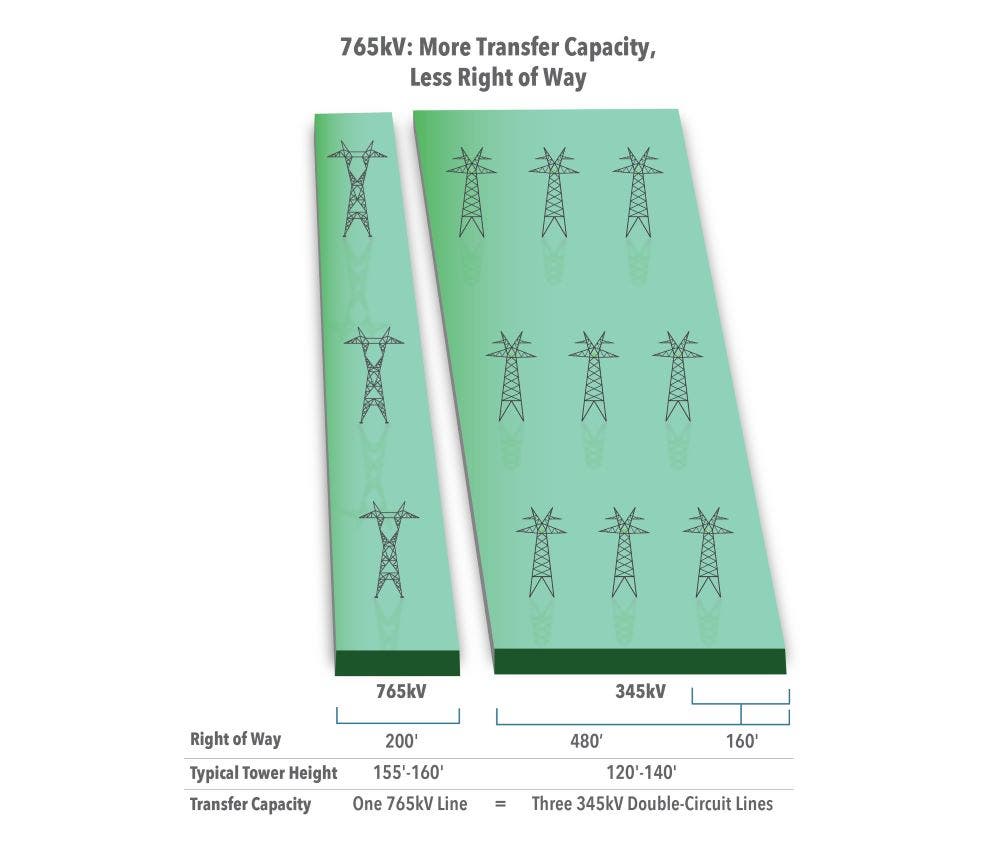
The current and forecasted growth of electric demand across Texas cannot be supported without expanding the state’s transmission network. If 765kV lines are not built, significantly more 345kV and 138kV infrastructure will need to be built in its place. One 765kV line delivers the same capacity as three 345kV double-circuit lines, with only a slightly wider footprint than just one 345kV line. Lower-voltage alternatives, such as multiple parallel 345kV or 138kV lines, would require significantly more time, investment and land impacts to move the same amount of electricity.


765kV-345kV Corridor Comparison

Improved Reliability, Resiliency, & Flexibility

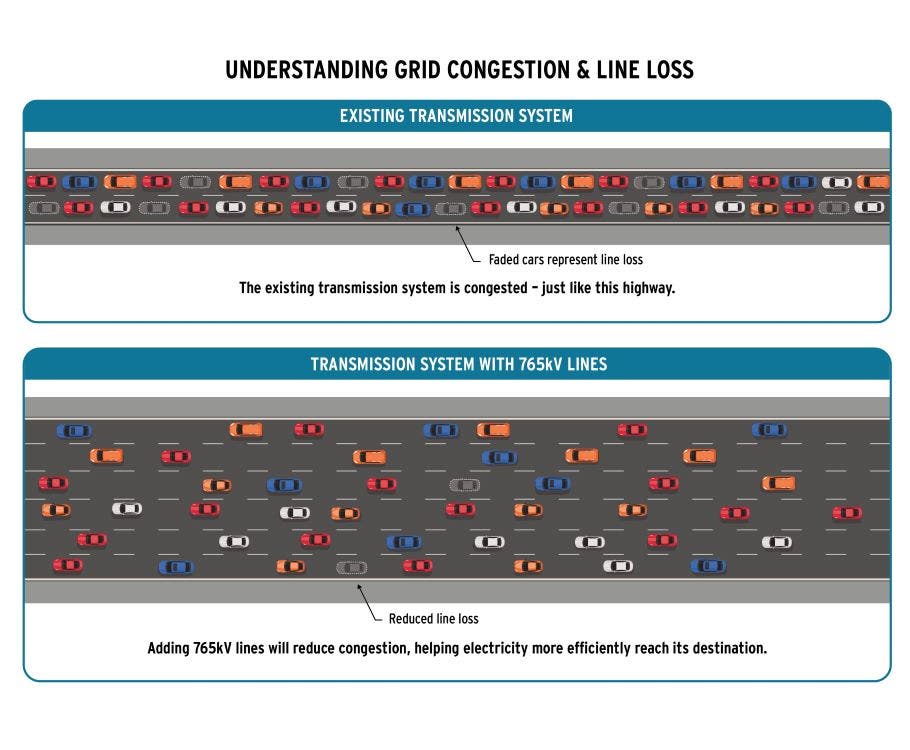
Strategically adding transmission capacity reduces problems like grid congestion and line loss, improving reliability for all customers. Grid congestion occurs when too much electricity from the most affordable generation tries to move through a power line at once. Line loss occurs when some electricity is lost as it travels long distances through power lines.


Congestion is a sign that the grid does not have enough transmission capacity to move power where it’s needed. Reducing congestion lowers the risk of transmission failure and load shedding and helps keep the lights on. This is especially helpful during extreme weather and times of high power demand. Congestion also increases costs for customers because ERCOT must dial down affordable generation and dispatch more expensive generation to alleviate constrained transmission lines, driving up overall market prices and monthly electric bills. ERCOT’s independent monitor found that transmission congestion cost ERCOT customers approximately $10 billion from 2020 through 2024. ERCOT’s economic analysis found that a 765kV buildout provides greater long‑term customer savings and congestion‑cost reductions compared to lower‑voltage alternatives.


Understanding Grid Congestion & Line Loss

Proven, Widespread Technology

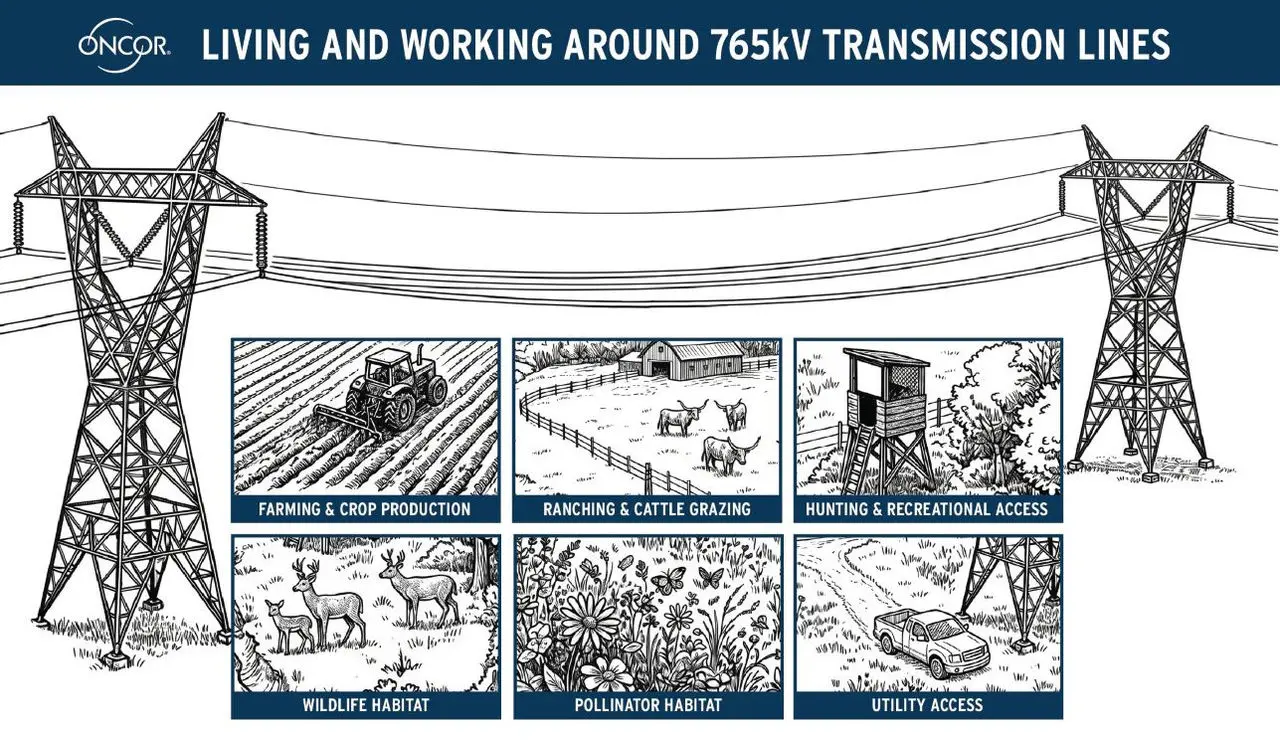
While new to Texas, millions of Americans live, work, farm, and operate businesses around 765kV transmission lines. They are a standard part of the transmission network in many parts of the world. More than 2,400 miles of 765kV lines are in use across the U.S. and Canada alone.


Living and Working Around 765kV Transmission Lines

OVERVIEW

Texas needs 765kV transmission lines because the state is experiencing unprecedented load growth, and the existing 345kV system is being pushed to its limits. In 2023, the Texas Legislature directed the PUCT to evaluate the need for new transmission infrastructure. That review found that 765kV extra‑high‑voltage (EHV) lines are the most efficient and least impactful way to strategically move large amounts of electricity around the state. In April 2025, the PUCT adopted the Permian Basin Reliability Plan and approved ERCOT’s recommendation to build the state’s first 765kV lines, citing higher efficiency, fewer required corridors, reduced congestion, and less landowner disruption compared to lower‑voltage alternatives, among other factors. Lower‑voltage alternatives, such as multiple parallel 345kV or 138kV lines, would require significantly more investment, and land impacts (ROW) to move the same amount of electricity.

The Permian Basin Reliability Plan is a statewide transmission reliability plan developed by ERCOT and approved by the PUCT to address rapid, unprecedented electric‑demand growth in West Texas. The plan identifies the new infrastructure needed to keep the region reliably powered, including Texas’ first 765kV transmission lines and targeted upgrades to the existing 345kV and 138kV networks. These projects will move more electricity into the region, relieve significant reliability concerns, reduce congestion, and support long‑term economic growth.

ERCOT has specifically identified urgent reliability concerns in the region that these lines will help address. These reliability concerns, which occur mainly at night under low‑wind conditions when local generation and import capability can’t meet regional demand, will increase as growth continues, which may ultimately require load shedding to mitigate further risks to the grid. It is critical to remember that the ERCOT grid is interconnected. Strengthening the Permian Basin strengthens the entire state and helps prevent the possibility of local transmission failures from cascading across the grid and affecting millions of Texans.

The 765kV Strategic Transmission Expansion Plan (STEP) is Texas’ long‑term vision to build a high‑capacity, statewide backbone of 765‑kilovolt transmission lines. This network is designed to meet rapidly rising electricity demand in high‑growth regions and provide the flexibility and resiliency needed to support Texas’ unprecedented current and future power needs. By creating a stronger, more interconnected transmission grid, STEP enables lower‑cost power to move efficiently across the state, enhances reliability during extreme conditions, and ensures Texas can continue to support economic expansion at scale. Oncor’s 765kV transmission projects represent key components of Phase One of STEP, laying the foundation for the broader statewide network envisioned in the plan.

No. While the needs of the oil and gas industry are a critical part of the Permian Basin Reliability Plan, 765kV transmission lines are not solely being built for any single industry or region. These new lines are being built to support the entire ERCOT grid and the millions of Texans who depend on it. Texas is experiencing historic statewide load growth, from population increases, expanding industries, and rising electricity needs across cities and communities. ERCOT has confirmed that the existing 345kV system cannot support future demand without major new infrastructure. The PUCT approved 765kV lines because they are the most efficient and least‑impactful way to strengthen the grid statewide, reduce congestion, and improve long‑term reliability.

Because ERCOT operates an interconnected statewide grid, strengthening high‑growth regions like West Texas improves reliability everywhere. A failure in one part of the grid has the potential to ripple across the system.

Yes. Communities along the route see direct financial benefits from these projects. First, the easement process includes extensive outreach, discussion, and good‑faith negotiation to ensure fair, appropriate, and market‑based compensation for each impacted landowner. With an easement, landowners continue to own and use their property in ways that do not interfere with the construction, operation, or maintenance of Oncor facilities. Beyond landowners, who are compensated for the easements needed to build and maintain the line with payments based on the rights acquired and the long‑term use of the property, new transmission infrastructure increases local tax revenues. Substations, towers, and other structures built as part of these projects would substantially increase property tax revenue in the communities where they are constructed, helping expand local tax bases to support schools, counties, local communities and essential public services. Oncor is one of the single-largest property taxpayers in Texas. As we expand our services to help meet current and future electric demand, our tax contributions also increase.

The cost of building and maintaining transmission lines is recovered in customer (ratepayers, not taxpayers) electricity bills. However, since transmission lines carry power around the state and therefore help benefit all Texans, that cost isn’t limited to Oncor customers, but spread across the entire ERCOT system. Growth can also help reduce impacts to customer electricity bills as more people and businesses moving to the ERCOT region means spreading transmission cost recovery among more customers. It’s also spread throughout the lifespan of the equipment, which can cover decades, meaning a smaller monthly impact. Studies have shown that 765kV lines can reduce long‑term system costs by cutting congestion and improving efficiency. For example, last year, ERCOT’s independent monitor found that transmission congestion cost ERCOT customers approximately $10 billion from 2020 through 2024. ERCOT’s economic analysis found that a 765kV buildout provides greater long‑term customer savings and congestion‑cost reductions compared to lower‑voltage alternatives.

PUBLIC INPUT

Oncor has made it a priority to share information about these projects and engage with local landowners, officials and other critical stakeholders through in-person meetings and other efforts. We began coordinating with key state and federal agencies in the fall of 2024, shortly after the approval of the Permian Basin Reliability Plan, to request initial information and help identify potential environmental or land‑use constraints. In the summer of 2025, Oncor held public meetings to obtain feedback from local residents and officials about the projects. Oncor has also responded to many emails, phone calls, letters and other communications from local community members regarding these projects. Additionally, landowners who live within approximately 500 feet of the proposed routes have been sent a notice with information about how they can engage in the PUCT’s regulatory process. Lastly, Oncor publishes information about all ongoing transmission projects at www.oncor.com/transmissionprojects.

Oncor believes public input is an important and welcome component of the carefully regulated process for proposing and building new transmission lines. We review and evaluate all of the public input we receive about our 765kV projects. This feedback has helped us modify several preliminary alternative route links submitted to the PUCT for consideration.

Those interested in PUCT proceedings for transmission projects can get involved either by requesting to become intervenors or by submitting comments as protestors. Prospective intervenors are people/entities that believe they are directly impacted by a proposed project; approved intervenors are full, active participants in PUCT proceedings that can make legal arguments, conduct discovery, file testimony, and cross-examine witnesses. More information about getting involved in PUCT proceedings can be found at  www.puc.texas.gov/agency/rulesnlaws/participate/.

GENERATION

Electricity demand in Far West Texas is growing significantly, with ERCOT reporting unprecedented load growth driven by oil and gas operations, industrial expansion, and rapidly increasing large-load interconnection requests. There is not enough existing or planned local generation to meet the region’s electricity needs. Even today, fully serving the region requires the existing 345 kV transmission system to import power from North Texas, Central Texas, and the Panhandle.

Local generation can be part of the solution, but it cannot replace the need for transmission. Generation produces power; transmission delivers power where and when it is needed. The Permian Basin needs both; local resources where available and high-capacity transmission to ensure power can be imported when local generation is unavailable, insufficient, or not producing at the times demand is highest.

Building more gas generation may help over time, but it is not a complete reliability strategy by itself. New generation must be planned, financed, permitted, interconnected, fueled, and available during the hours when the grid needs it most. Even if additional generation is built in the region, the power still needs transmission infrastructure to move reliably to customers.

That is why the choice is not “generation or transmission.” The 765 kV lines solve a different problem: ensuring ERCOT can deliver large amounts of power into the Permian Basin when needed and move power across the system efficiently and securely. They provide the import capability, flexibility, and resilience needed to support the region’s growth.

The existing 345 kV system is no longer enough to keep pace with the region’s load growth. Far West Texas experiences far more transmission congestion than any other part of the ERCOT system, especially at night, when demand in the region exceeds what local generation can provide and the existing transmission system approaches its import limits. While ERCOT has approved a number of improvements to the 345 kV system over the past decade, those upgrades are not enough to meet the scale of growth now occurring in the region.

In the near future, customers in Far West Texas could face an increasing risk of temporary outages, including controlled outages ERCOT may use to maintain system reliability and avoid an uncontrolled, cascading blackout. Without adding 765 kV transmission lines, the region’s already-urgent reliability concerns will continue to worsen.

That is why ERCOT and the PUCT approved the Permian Basin Reliability Plan, which includes new 765 kV transmission lines to bring power into the region efficiently and securely. These lines strengthen not just the Permian Basin, but the broader ERCOT grid, helping prevent localized issues from spreading and improving reliability statewide.

Transmission lines, especially 765kV lines, move electricity more efficiently and reduce grid congestion, allowing power to flow where it’s needed as demand grows across Texas. These higher‑capacity lines will help keep the grid reliable for decades to come while addressing current challenges of congestion and rapid load growth.

Oncor is a regulated Transmission and Distribution Utility and under Texas’ deregulated market structure, utilities like Oncor are prohibited from generating electricity on the grid. Power plants are built and operated by competitive generators, while Oncor’s role is to safely deliver that power through its transmission and distribution network. In Texas’ deregulated market, competitive generation companies—not utilities—build and operate power plants and sell their electricity into the ERCOT wholesale market. ERCOT is also prohibited from constructing or directing the construction of generation.

ROUTING

The regulatory process for building any new transmission line requires Oncor to propose a geographically diverse set of routes for the PUCT to consider. Oncor researched and developed hundreds of viable proposed route links for these projects. As part of the route development process, Oncor thoroughly examined the proposed projects’ potential impacts on private property, the environment, and many other factors. Our detailed findings were then recorded in the projects’ environmental assessment and routing studies, which are included as part of the projects’ CCN applications. One routing criterion that Oncor must meet is that all of our possible route proposals must be “reasonably forward-progressing” from one endpoint to the other. The endpoints for Oncor’s 765kV transmission line projects were identified by ERCOT through system‑wide reliability planning under the Permian Basin Reliability Plan.

When developing proposed routes for a new transmission line, Oncor is required to consider potential impacts on property values, environmental impacts, historical and aesthetic values, possible effects on recreational and park areas, as well as cost, engineering constraints, and potential use of existing right of way (ROW). It’s a thorough, highly scrutinized, and highly regulated process. Oncor also recognizes that local input is critical to the route development process. Feedback from local residents and officials also helped us modify several of the preliminary route links we eventually submitted to the PUCT for consideration.

Yes. When routing new transmission lines, Oncor evaluates opportunities to parallel existing transmission corridors as well as other established infrastructure, such as utility rights‑of‑way, pipelines, railroads, and routes that run parallel to highways, when those options are reasonable and consistent with engineering, safety, environmental, and land‑use requirements. Using existing linear infrastructure can help reduce new land impacts, though all potential routes must still be “reasonably forward‑progressing” between endpoints.

However, paralleling is not always feasible. For 765kV lines in particular, placing a new line directly adjacent to an existing corridor can increase the risk that a single event could affect both systems, so maintaining appropriate spacing supports overall grid reliability and resilience. Likewise, highway‑parallel routing is only feasible in locations where it does not conflict with other routing priorities such as avoiding communities, schools, or sensitive environmental features. As part of every CCN filing, Oncor provides the PUCT with multiple geographically diverse routing alternatives, some of which may include corridor‑ or highway‑parallel segments when appropriate.

HEALTH & SAFETY

Decades of scientific research have shown that exposure to transmission lines does not cause adverse health effects. While transmission lines generate magnetic fields, they are extremely small, matching that of household appliances at the edge of the ROW, and pose no health risk.

No. While this technology is new to Texas, there are more than 2,400 miles of 765kV lines in use across the U.S. and Canada. Importantly, millions of Americans live, work, farm, and operate businesses around these lines today across states like Ohio, Indiana, West Virginia, Kentucky, and Virginia. Their long and widespread use across rural, suburban, and industrial areas shows that 765kV infrastructure is not experimental. It is a standard part of the transmission network in many parts of the U.S. and worldwide.

In addition, the designs used for modern 765kV systems build on decades of proven engineering practices. Oncor is able to leverage existing industry design knowledge, standards, and operating experience from utilities that have safely operated 765kV systems for years.

ENVIRONMENT

Oncor conducts a detailed environmental assessment and routing study as we develop alternative routing options for a proposed transmission project. This work includes a thorough evaluation of the project area’s community values and resources, cultural resources, land use, threatened and endangered plant and animal species, and more. We adhere to all applicable environmental regulations, as well as Texas Utilities Code § 37.056(c)(4)(A)-(D), which requires Oncor to consider a proposed project’s impact on environmental integrity.

The impacts of transmission lines on bodies of water can vary depending on factors specific to the crossing area. Oncor does attempt to cross major rivers at close to perpendicular angles to minimize any potential impacts. Based on the results of the environmental assessment, Oncor does not expect the transmission line to have any significant impact on the San Saba River, during construction or otherwise.

None of the proposed routes for the Dinosaur- Longshore project cross Dinosaur Valley State Park.  Further, Oncor’s environmental assessment for the Dinosaur-Longshore project concluded that the project is not anticipated to adversely impact Dinosaur Valley State Park and other nearby recreation areas.  

LAND ACQUISITION & RIGHT OF WAY

The standard ROW width for a 765kV transmission line is approximately 200 feet. In comparison, three double-circuit 345kV transmission lines, which transmit the same amount of power as a single 765kV transmission line, require 480 feet of ROW.

The typical height of the steel lattice tower structures being built for these projects will be 155-160 feet. The estimated maximum height of these towers will be up to just under 200 feet. Comparatively, the typical height of a 345kV transmission tower is approximately 120-125 feet, with a maximum height of approximately 190 feet, depending on terrain, local clearances and engineering designs.

Once construction is complete, most day‑to‑day uses of the land within the easement, such as grazing, crop production, and other agricultural activities, typically can continue. Greenbelts, open space, and other low‑impact land uses may also remain compatible with transmission operations.

After the PUCT selects the final route for this project, Oncor will thoroughly survey the route to determine specific engineering, environmental, and ROW needs. (Preliminary surveys of multiple routes, taken from public right of way access areas, may take place prior to PUCT approval of a final route in order to support project timelines.) After all these determinations are completed, Oncor will begin working with impacted landowners to acquire easements.

CONTACT US


If you would like to reach out to us about our 765kV projects, please email transmissionprojects@oncor.com or use the comment form below. If you are a journalist, please call our 24/7 media hotline at 877-426-1616.

ADDITIONAL RESOURCES